
 By Olivia Wilson Media Team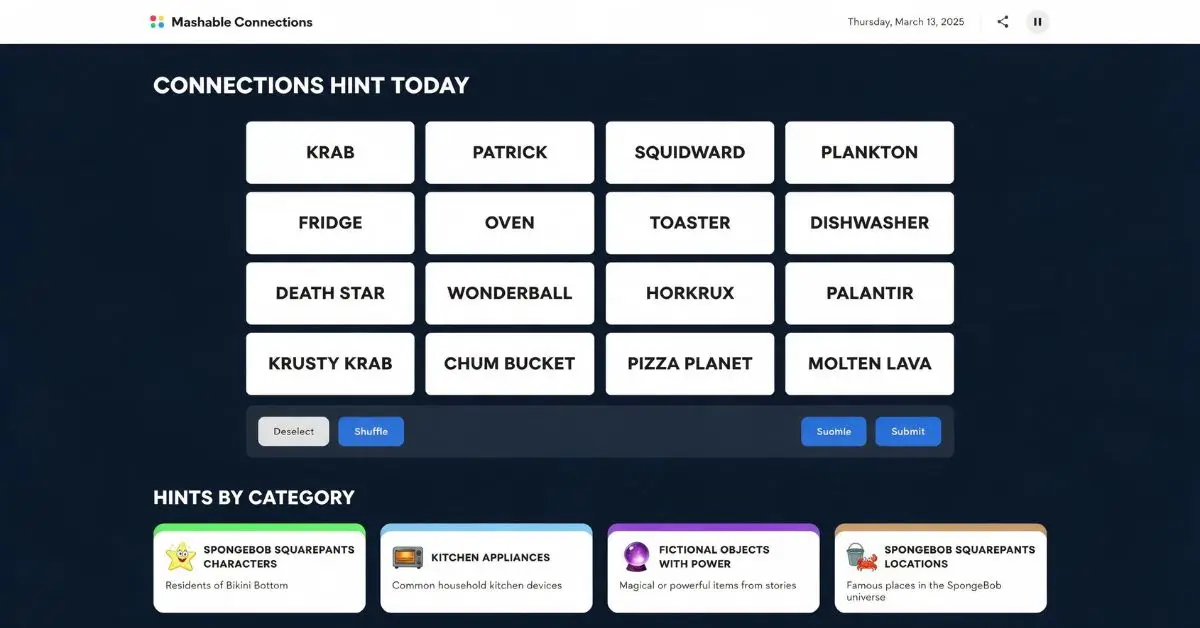
Every morning, millions of people open the NYT Connections puzzle with the same quiet confidence. And every morning, a good number of those same people find themselves completely stuck somewhere around the third or fourth category, burning through guesses on words that seem like they fit everywhere and nowhere at the same time.
That is not a sign you are bad at the game. It is a sign the game is working exactly as designed.
NYT Connections is built to mislead you. The difficulty is intentional. The red herrings are deliberate. And the reason mashable connections hint today searches spike every single morning across the United States, UK, and Canada is that even experienced players regularly hit a wall they cannot break through alone.
This guide explains how Mashable’s daily hint system works, why it has become one of the most trusted daily resources for Connections players, and what strategies will genuinely make you better at solving the puzzle with or without outside help.
Mashable connections hint today refers to the daily hint articles published by Mashable to help players solve the New York Times Connections word puzzle. Each article provides structured, layered clues for that day’s puzzle categories, ranging from vague thematic nudges to full category reveals for players who need them. Mashable formats these hints so readers control exactly how much help they receive without being forced to see complete answers before they are ready.
Mashable publishes daily Connections hints in a layered format that lets you choose how much help you get. This guide explains how those hints are structured, how the game works, and the strategies that will help you solve more puzzles on your own every day.
Mashable is not the only publication covering the NYT Connections puzzle daily. Tom’s Guide, Parade, and several other sites publish hints too. But Mashable has consistently ranked among the most visited sources for this content, and the reason is format.
Most hint sites do one of two things wrong. They either hint so broadly that you gain nothing, or they hand you the full answer in the first paragraph with no way to avoid seeing it. Neither approach respects what most players actually want, which is just enough direction to solve it themselves.
Mashable threads that needle consistently. Their daily hint articles are structured in clear layers. You can read the first section, get a nudge in the right direction, and stop there. If you need more, the next section goes slightly deeper. If you are completely stumped and just need the answer, it is there, but it is placed far enough into the article that you will not accidentally see it before you are ready.
That structure is genuinely useful. It is also why mashable connections hint today has become a daily ritual for a significant portion of the game’s most engaged players.
Before the hints make full sense, it helps to understand exactly what you are solving each day.
The puzzle gives you sixteen words arranged in a four-by-four grid. Your job is to identify four groups of four words that each share a hidden theme or connection. The categories are color-coded from easiest to most difficult.
Yellow is the straightforward category. The connection is usually clear and direct. Green is a step harder. Blue requires more lateral thinking. Purple is the most difficult and almost always involves wordplay, double meanings, or a connection that deliberately contradicts your first instinct.
You get exactly four chances to guess correctly before the game ends. Every wrong guess counts against you. This means the cost of guessing before you are confident is real and immediate.
The game resets every day at midnight and is free to play on the New York Times Games website and app. Each puzzle is created by a different puzzle editor, which means the style, difficulty, and type of wordplay shifts slightly from day to day. This inconsistency is part of what makes the game interesting and part of what makes consistent solving genuinely difficult.
Understanding the format helps you use it more effectively.
When you open a mashable connections hint today article, the structure typically follows a deliberate progression.
The opening section confirms the puzzle date and gives a brief, general impression of the day’s difficulty. This alone is useful context. Knowing whether today’s puzzle is particularly tricky helps you calibrate how much effort to put in before seeking help.
The category hints come next. Each of the four color categories gets its own clue, phrased to give you a directional nudge without naming the connection outright. A hint for a category about car brands might say something like “think about names that also belong to luxury vehicles” rather than simply writing “car brands.”
The one-away hints are often included for the purple category specifically. These tell you that you are one word away from a correct group, which helps you identify the misplaced word without revealing the full answer.
The full answers are placed at the bottom, clearly labeled, and separated from the hint sections so you have to intentionally scroll to reach them. This design choice is deliberate and genuinely appreciated by players who want to use hints responsibly.
Hints help when you are stuck. Strategy prevents you from getting stuck as often. These approaches are tested and practical.
This sounds obvious but most players ignore it. Spend two full minutes reading all sixteen words before making any selections. Your brain processes connections passively. Words that seem unrelated on first glance often form visible patterns after a short period of quiet observation.
Making a guess in the first thirty seconds almost always leads to mistakes. Patience at the start of the puzzle pays off in the final categories.
If a group of four words seems immediately, obviously connected, there is a reasonable chance one of those words belongs somewhere else. The puzzle makers know what the obvious grouping is. They designed the puzzle to include it as a trap.
A puzzle with the words “rose,” “violet,” “lily,” and “iris” looks like a flower category. But in a real NYT Connections puzzle, “iris” might belong to a category about parts of the eye, and “violet” might belong to a category about shades of purple. The flower group contains four different words entirely.
Train yourself to ask, for every obvious group: is there any reason one of these words might belong somewhere else?
The shuffle button rearranges all sixteen tiles randomly. This is not just a cosmetic feature. It changes the spatial relationships between words, and that change regularly reveals groupings that were not visible in the original arrangement.
Many experienced players shuffle three or four times before committing to a guess. It costs nothing and takes seconds.
Start with your most confident category and work toward the hardest. Yellow first, then green, then blue, then purple. By the time you have correctly identified twelve words, the remaining four almost always become clear even if you have not fully worked out the exact theme.
Attempting purple early burns guesses on words that could reasonably belong to multiple groups. Saving it for last almost always makes it easier.
This sounds low-tech, but it works. When you are stuck between two possible groupings, writing the options on paper or a notes app lets you see the problem differently. Staring at the screen keeps the same visual pattern in front of you. Physically writing the words out breaks that pattern.
A teacher in Austin, Texas who plays daily described this habit as the single biggest improvement to her solve rate. When she is torn between two possible groups, she writes out both options and looks at what the remaining words would be in each scenario. The correct grouping almost always becomes obvious when she approaches it this way.
Understanding what goes wrong most often helps you avoid those specific errors.
Locking onto the first pattern you see. The puzzle is designed to make one wrong grouping look very convincing. Players who commit too quickly to their first instinct regularly waste two or three guesses before realizing the mistake.
Ignoring wordplay possibilities. A significant portion of Connections categories involve words that combine with a shared word, words that follow a specific phrase, or words with double meanings. If you are only reading words at face value, you will miss a large category of connections entirely.
Treating all four guesses as equally expendable. Your fourth guess is your last chance. Never use it until you are completely certain. If you have three categories confirmed and four words remaining, those four are your final group by elimination, even if you never figured out what they have in common.
| Situation | Best Approach |
|---|---|
| Obvious group of four | Question it before committing |
| Stuck after two categories | Shuffle tiles and look again |
| One word feels out of place | It probably is, find where it belongs |
| Purple category unclear | Leave it last, use elimination |
| Down to last guess | Only guess if completely certain |
| Totally stuck | Use mashable connections hint today for one category only |
This table gives you a quick decision guide for the moments when the puzzle feels like it has no clear path forward.
The NYT Connections puzzle is one of the most genuinely engaging daily games available right now, and mashable connections hint today has earned its place as a trusted daily resource for players who need structured help without having the full answer handed to them.
Use the strategies in this guide to strengthen your independent solve rate. Use Mashable’s hints when you genuinely need them. And remember that the goal is never just to finish the puzzle. It is to enjoy the process of solving it.
It is a daily Mashable article offering layered hints for the NYT Connections puzzle, from subtle clues to full answers.
Difficulty varies daily. Yellow and green groups are usually easier, while blue and purple often require more lateral thinking.
Yes. The daily Connections puzzle is free on the New York Times website and app.
Daily puzzle hints meet strong reader demand and help players who need guidance without immediately revealing the answers.
Try the next hint layer before checking the full answer. You can also use another reputable hint source for a different perspective.
[…] For example, a gamer in Ohio running an AMD Radeon RX 6700 XT saw frame rates in Cyberpunk 2077 jump from 52 FPS to 68 FPS simply by updating from an outdated Mesa release to the latest stable version. […]